Newborn skin in the first month: does it need anything at all? What it actually needs (less than you think)
In the first month, newborn skin needs less than you think. Plain water baths 2 to 3 times a week are enough, peeling and vernix are normal, choose fragrance-free if anything, and skip olive oil.

You’re a few days home from the hospital. Your baby’s hands and feet have started to flake, there are tiny bumps on their face, and the grown-ups in the family have handed you a full set of oils, powders and lotions. Of course you want to do something to help.
Here’s the honest answer: in the first month, baby’s skin needs far less than most of us think. Plain water, a soft towel and a bit of patience cover most of it. Let’s go through what’s normal, what to do, and when to see a doctor.
Is it normal for newborn skin to peel or have a white coating?
Quick Answer: Yes. Let the white coating from birth soak in on its own, and the peeling will come off by itself within a few days. No cream needed.
The white, creamy coating on your baby at birth is called vernix. It’s a natural cream that protected their skin in the womb. NHS advice is to leave it on the skin to absorb naturally rather than rubbing it off.
Peeling and flaky skin on the hands, feet and in the creases is normal too. After nine months in fluid, the skin meets the air, the top layer peels away, and there’s smooth new skin underneath.
- Don’t pull or scrub the flakes
- The NHS says you don’t need creams or lotions for peeling at this stage, since they may not help and can make things worse
- For bits stuck in the hair, a soft baby comb works instead of shampoo for the first few weeks
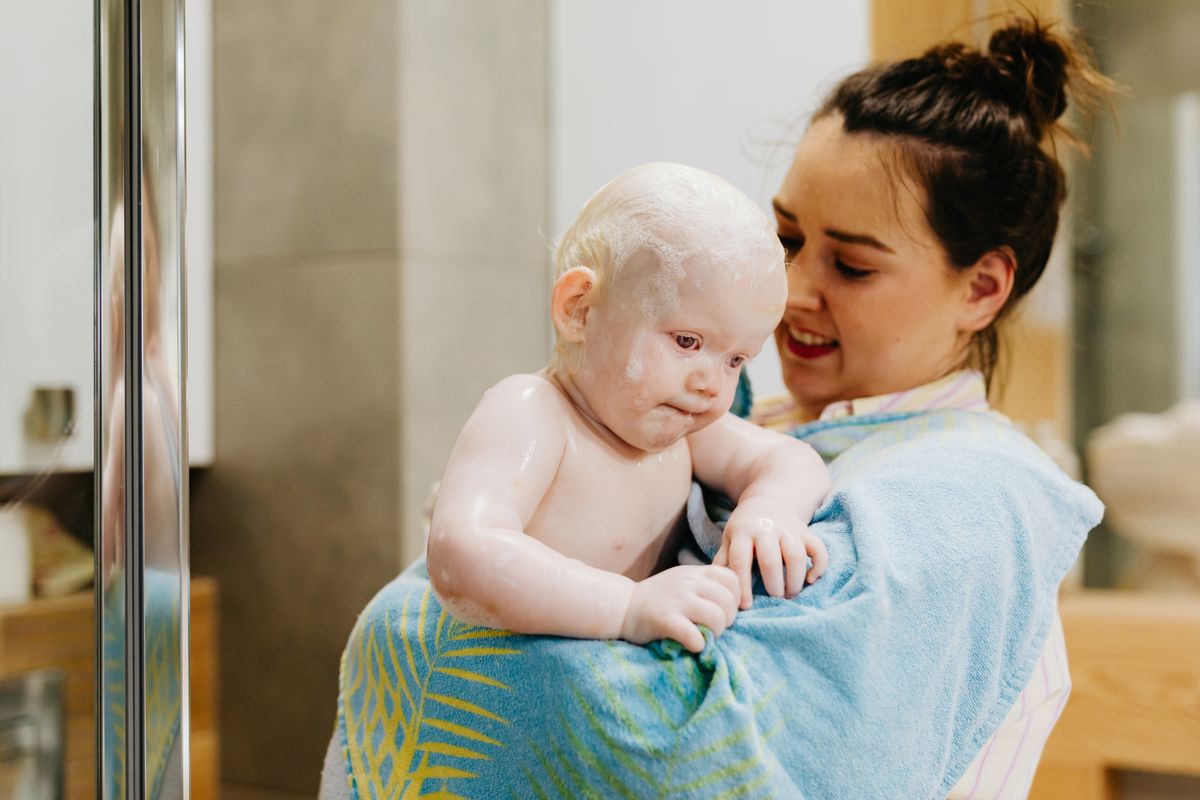
How often should a newborn have a bath?
Quick Answer: 2 to 3 times a week is enough. A daily bath isn’t necessary.
The NHS says 2 or 3 times a week is fine. The AAP (American Academy of Pediatrics) suggests about three times a week in the first year, because babies don’t sweat much or get very dirty yet, and bathing more often can dry out their skin.
We get it: it’s hot here, and many grandparents are used to a morning and evening bath. Don’t worry. If your baby enjoys a daily bath, the NHS says that’s fine too, just keep it short with plain water. On days without a bath, wipe the face, neck creases, hands and bottom clean.
Until the cord stump falls off, the AAP recommends sponge baths instead of putting baby in the tub.
Soap or just plain water in the first month?
Quick Answer: Plain warm water is best in the first month. No soap or baby wash needed.
The NHS is clear that you don’t need any cleansers in the first month, because plain water is best for baby’s skin. Some NHS hospital trusts explain why: newborn skin takes a few weeks to build its own protective barrier, and products used too early may cause irritation or rashes.
- If an area is very messy, like a big poop, use a little mild, fragrance-free soap and rinse it off right away (AAP)
- Some NHS trusts suggest holding off on baby wipes until around 2 to 4 weeks, and using cotton wool with warm water before then
- Premature babies’ skin takes longer to mature, and one NHS trust advises avoiding skin products for about 6 to 8 weeks. Check with your baby’s care team
Do I need to use lotion or oil?
Quick Answer: Usually not. The NHS suggests waiting until your baby is at least 1 month old before using lotions or oils. If there are genuinely dry patches, use a thin layer of something fragrance-free.
The advice differs a little between countries, so here it is plainly:
- NHS (UK): avoid lotions and oils until at least 1 month. After that, if the skin is dry, use a small amount of something free from alcohol, colour and perfume
- AAP (US): after a bath, pat dry and apply a small amount of fragrance-free moisturizer to help prevent dry skin
Where both agree: fragrance-free, a little at a time, and only when the skin is dry. If your baby’s skin is soft and fine, you don’t need to put anything on at all.
Does daily moisturizing really prevent eczema?
Quick Answer: The current evidence doesn’t support it. A large review found that moisturizing healthy babies probably doesn’t prevent eczema.
If you or your partner have eczema, you may have heard that moisturizing your baby every day from birth can prevent it. The truth is that studies haven’t all pointed the same way, and the biggest summary of the evidence came out like this:
- A 2022 Cochrane review pooled 33 studies with more than 25,000 participants and found that skin care in the first year probably doesn’t prevent eczema
- Babies in the moisturizing groups had a slightly higher chance of skin infections
- For food allergy, there’s too little evidence to say either way
In short: moisturize when the skin is dry, but don’t feel guilty about skipping a daily routine. If allergies clearly run in your family, bring it up with your pediatrician at your next check-up, and note it in your baby’s health record. For how eczema differs from contact allergy, read My child reacts to everything I put on their skin.
Can I use olive oil on my baby?
Quick Answer: It isn’t recommended. Research found that olive oil weakens the skin barrier.
Olive oil feels natural, so many families reach for it for baby massage. But a study by Danby, Cork and colleagues, published in Pediatric Dermatology in 2013, had volunteers apply olive oil to their forearms twice a day for 4 weeks. It damaged the outer layer of the skin and caused mild redness. The researchers advised against using olive oil for dry skin or infant massage.
- The study was done on adults, not babies, but it was designed to inform newborn skin care
- The NHS also advises avoiding olive oil, and peanut oil because of the allergy risk, when treating cradle cap
- The researchers said the belief that all natural oils are good for skin isn’t backed by evidence
If grandma wants to massage the baby, you could gently mention that doctors suggest waiting until after 1 month, then pick something fragrance-free together.
Looking for something simple and fragrance-free?
Quick Answer: If you’re past the first month, or your baby has dry patches, and you’d like something with a short ingredient list and no fragrance or essential oils, these are a few to look at.
We picked them from the labels the brands publish: short, readable ingredient lists made from plant oils or butters (listed alphabetically).
- Green People Organic Babies Scent Free Baby Oil (UK): seed oils such as sunflower, sesame and evening primrose, no scent. The brand says all ingredients are organic. Available online.
- Neal’s Yard Remedies Organic Baby Balm (UK): a balm of sunflower oil, coconut oil, shea butter and beeswax, fragrance-free. The brand says it’s suitable for newborns from 3 kg. Available online.
- Skinhug Pure Green Nourishing Seed Oil (Thailand, Chiang Mai): a blend of 8 seed oils, no fragrance, no essential oils, no mineral oil. The brand says it’s suitable from birth, and it’s notified with the Thai FDA. (connected to our team)
Whichever you choose, apply a thin layer only on dry spots, patch test a small area for a day first, stop if you see redness or a rash, and check with your doctor first if your baby was born early. For a full guide to reading labels, see our baby oil comparison.
How do I care for the cord, heat rash and diaper rash?
Quick Answer: Keep the cord dry, treat heat rash by cooling baby down, and treat diaper rash with frequent changes and dry skin.
Cord stump
- Keep it dry. Fold the top of the diaper down below the stump and change diapers often, since a wet diaper slows drying and raises the risk of infection
- If pee gets on it, gently clean the base with warm water and pat dry
- It falls off by itself, usually within about 1 to 3 weeks. Don’t pull it, even if it’s hanging by a thread
- Some Thai hospitals still teach alcohol cleaning. For why the advice differs, read Umbilical cord stump not off yet: do you need alcohol every day?
Heat rash
- Shows up on the neck, armpits and diaper area when baby gets too warm
- Dress baby in thin layers, don’t over-wrap, and keep the room airy. It usually clears in a couple of days
- Skip the powder. Here’s why: Baby powder after the bath
Diaper rash
- Change the diaper as soon as it’s wet or dirty
- Clean with warm water. While there’s a rash, avoid soap and wipes
- Let the skin dry fully, and if you can, give baby some diaper-free time on a towel
- Apply a thin layer of zinc oxide ointment or paste
Do baby acne, white spots and cradle cap need treatment?
Quick Answer: Mostly no. They’re normal in newborns and clear up on their own. Just don’t squeeze or pick.
| What you see | What it looks like | What to do |
|---|---|---|
| Milia | Tiny white spots, 1 to 2 mm, on the nose, cheeks and chin. About half of newborns get them | Leave them. Usually gone within 4 weeks |
| Newborn red rash (erythema toxicum) | Red, blotchy patches that come and go in the first 3 to 4 days, baby is otherwise well | No treatment, it goes on its own |
| Baby acne | Red or white bumps on the cheeks, nose and forehead, starting around 2 to 4 weeks | Plain water only, no squeezing. Usually clears in 3 to 4 months without marks |
| Cradle cap | Yellowish, greasy scales on the scalp, sometimes the face, ears and neck | Not itchy, not painful, not contagious. Usually clears in a few months |
For cradle cap, the NHS suggests gently massaging an emollient (a gentle moisturizer) or coconut oil into the scalp to soften the scales, brushing softly, then washing with baby shampoo. Don’t pick the crusts, since that raises the chance of infection, and avoid olive oil, peanut oil, adult shampoo and anything perfumed. A little hair coming away with the scales is normal and grows back.
If your baby’s skin looks yellow, that’s not a dry skin issue. Read Newborn jaundice: does your baby really need sunlight?
When should I take my baby to a doctor?
Quick Answer: A rash that doesn’t fade under a pressed glass, or a fever of 38°C (100.4°F) or higher in a baby under 3 months, means go to the hospital now. Don’t wait and see.
Go to the hospital straight away if
- There are red or purple spots that don’t fade when you press a clear glass against them
- Your baby is under 3 months and has a temperature of 38°C (100.4°F) or higher, or below 36°C. More in Fever in a baby under 3 months
- The yellow color is getting deeper, and baby is feeding poorly, has fewer wet diapers, or is hard to wake
Call the doctor or get seen the same day if
- There are blisters, pus-filled spots or open sores
- The skin around the cord is red, warmer than the skin around it, tender to touch, or there’s discharge or a bad smell
- Diaper rash isn’t better after several days of care, is draining pus, or baby seems very uncomfortable
- Cradle cap covers most of the body, bleeds or leaks fluid, looks swollen, or hasn’t improved after a few weeks of care
- The skin stays red and irritated even after using a fragrance-free moisturizer
If you’re unsure, call the nurses at the maternity ward or the children’s clinic at the hospital where you gave birth. No question is too small.
Summary
In the first month, your baby’s skin is getting used to the world outside. A bit of peeling, a few spots, and most of it is normal and clears up by itself. Plain warm water 2 to 3 times a week, pat dry, and a little fragrance-free moisturizer only if the skin is dry. That truly is enough. Doing less doesn’t mean caring less.
Questions parents ask
01My newborn's skin is peeling. Do I need to put cream on it?
No. Peeling in the first weeks is normal, and the top layer comes off by itself within a few days. The NHS says creams or lotions at this stage may not help and can make things worse.
02Does a newborn need a bath every day?
No. The NHS says 2 or 3 times a week is fine, and the AAP suggests about three times a week in the first year, because bathing more often can dry out the skin. In between, just keep the face, neck and diaper area clean.
03Should I use soap on my newborn?
Plain warm water is enough in the first month. The NHS says plain water is best for baby's skin in the first month. If an area is very dirty, use a little mild, fragrance-free soap and rinse it off straight away.
04Can I use olive oil on my baby?
It isn't recommended. A 2013 study found that olive oil weakened the skin barrier, and the NHS also advises avoiding olive oil when treating cradle cap.
05Does moisturizing every day prevent eczema?
The evidence isn't there yet. A 2022 Cochrane review of 33 studies found that moisturizing healthy babies probably doesn't prevent eczema and may slightly raise the chance of skin infections. If allergies run in your family, talk to your pediatrician first.
06My newborn has pimples on their face. What should I do?
Baby acne usually appears 2 to 4 weeks after birth and doesn't leave marks. Leave it alone and wash with plain water. Don't squeeze or put anything on it. It usually clears within a few months.
07Which rashes mean I should take my baby to a doctor?
A rash that doesn't fade when you press a clear glass against it, blisters or pus-filled spots, or a fever of 38°C (100.4°F) or higher in a baby under 3 months. Get medical help straight away.
Can't find what you're looking for?
Ask us anything about family life in Thailand. No name needed. We read every question, and the ones parents ask most become new guides.
Sources
- Neal's Yard Remedies: Organic Baby Balm
- Green People Organic Babies Scent Free Baby Oil (Medino listing)
- Skinhug: Pure Green Nourishing Seed Oil
- NHS: Bathing your baby (Start for Life)
- NHS Northern Lincolnshire and Goole: Skincare for newborn babies
- HealthyChildren.org (AAP): Bathing Your Newborn
- Danby SG, Cork MJ et al. (2013) Effect of olive and sunflower seed oil on the adult skin barrier: implications for neonatal skin care. Pediatric Dermatology 30(1):42-50
- Cochrane (2022): Skin care interventions in infants for preventing eczema and food allergy
- NHS: Cradle cap
- NHS Healthier Together: Rashes in newborn babies
- Cincinnati Children's: Skin Conditions in Newborns
- Cincinnati Children's: Umbilical Cord Care
- KidsHealth (Nemours): Diaper Rash
- HealthyChildren.org (AAP): Fever, When to Call the Pediatrician